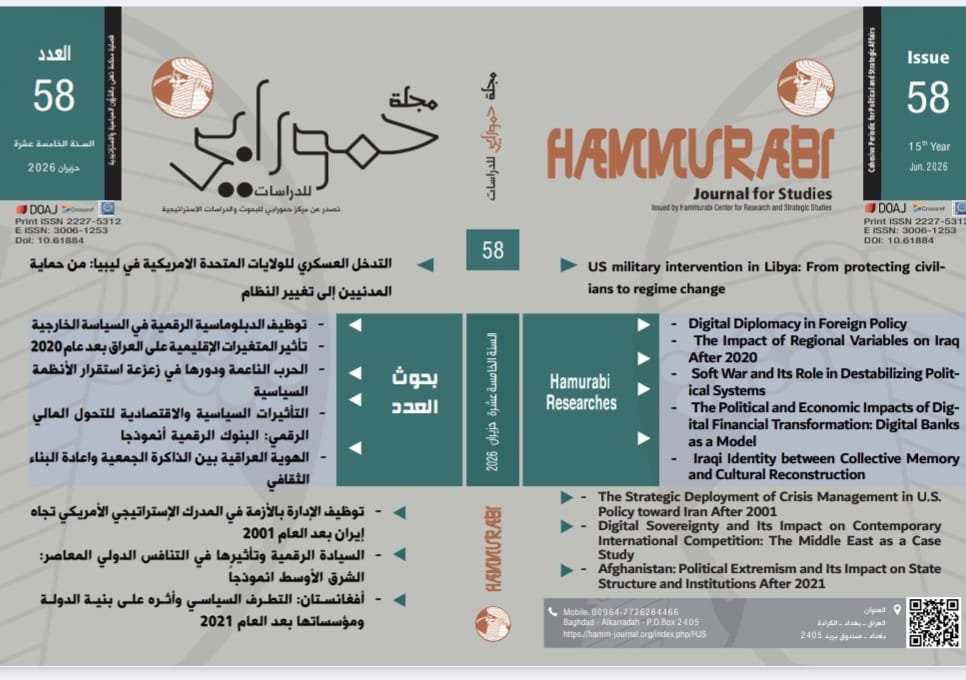
Afghanistan: Political Extremism and Its Impact on State Structure and Institutions After 2021
DOI:
https://doi.org/10.61884/hjs.v14i58.752Abstract
Political extremism represents a grave societal phenomenon that poses a significant threat to social cohesion and stability. It contributes to deep national fragmentation by generating structural divisions within the social fabric, thereby undermining unity among the diverse components of a single society. This dynamic is largely attributable to the tendency of extremist actors to adopt violence as a principal instrument for advancing their objectives and ideological convictions. In addition, such actors may resort to forms of intellectual and psychological coercion directed against those who dissent from their views or obstruct the realization of their ideological agenda.
Downloads
Published
2026-06-01
How to Cite
Assist. Prof. Dr. Heba Ali Hussein, A. P. D. H. A. H. (2026). Afghanistan: Political Extremism and Its Impact on State Structure and Institutions After 2021. Hammurabi Journal for Studies, 15(58), 147–166. https://doi.org/10.61884/hjs.v14i58.752