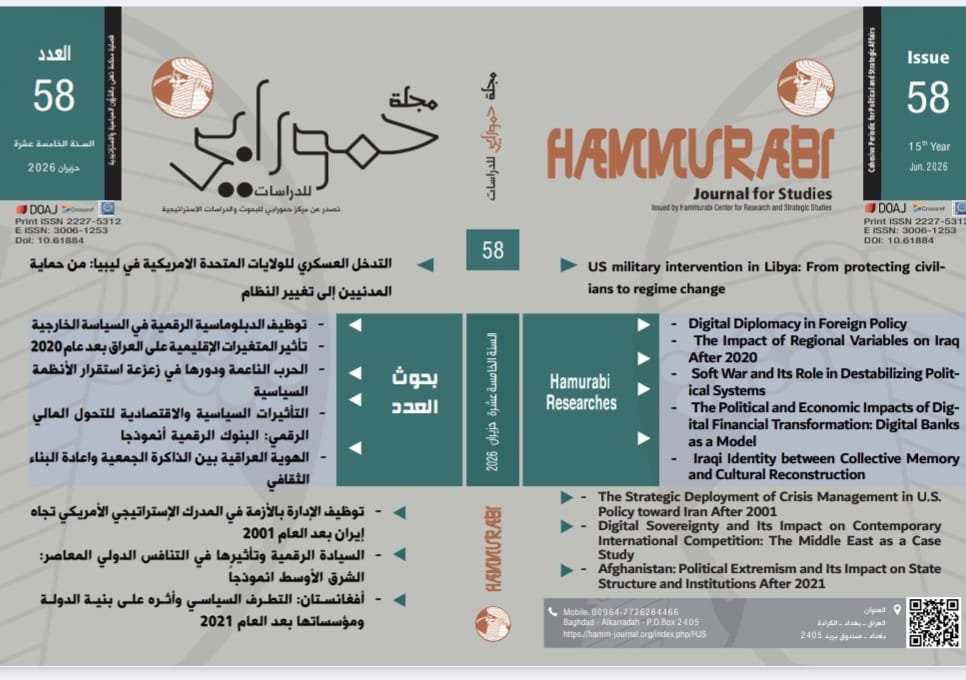
Digital Sovereignty and Its Impact on Contemporary International Competition: The Middle East as a Case Study
DOI:
https://doi.org/10.61884/hjs.v14i58.763Abstract
This study examines the role of digital sovereignty as a central strategic framework in contemporary international competition. Control over data, digital infrastructure, and advanced technologies has emerged as a critical determinant of state power. The research analyzes the competition between the United States and China as a global model for leveraging cyberspace as a tool of influence and strategic power projection.The study further applies this analysis to the Middle East, with a focus on regional competition between the Kingdom of Saudi Arabia and the Islamic Republic of Iran. It illustrates how digital sovereignty can be strategically employed to enhance regional influence and reshape power balances. Consequently, digital sovereignty is not merely a technical instrument encompassing digital infrastructure; it constitutes a strategic framework that directly affects states’ capacity to manage international relations and expand their global digital influence.