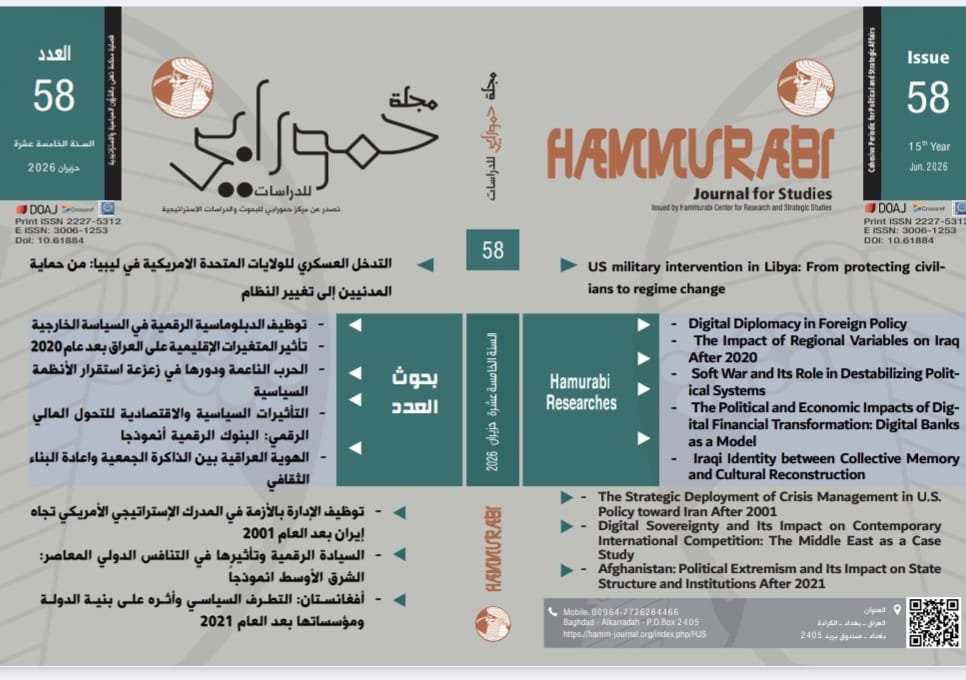
US military intervention in Libya: From protecting civilians to regime change
DOI:
https://doi.org/10.61884/hjs.v14i58.761Abstract
The strategy of "Hybrid Military Intervention" adopted by the United States in managing the Libyan crisis in 2011, focusing on the fundamental shift in intervention objectives from "protecting civilians" under UN Resolution 1973 to political "regime change." The study employs a descriptive-analytical approach to deconstruct the tools of this intervention, which combined air power (NATO), cyber and intelligence operations, and support for local armed actors, without a large-scale deployment of ground forces. The study concludes that this hybrid model achieved the U.S. tactical goal of overthrowing the Gaddafi regime at minimal cost; however, strategically, it led to the collapse of Libyan state institutions and the prevalence of a "non-state" condition due to the absence of post-conflict reconstruction plans.